The Complete CAM Marketing Strategy Guide
How HOA Management Companies Win More Communities
Online—and Keep Them
Table of Contents
- Why Most CAM Companies Are Losing Leads Before They Ever Get the Call
- How HOA Boards Actually Search for Management Companies
- Your Website Is Either a Lead Machine or a Lead Graveyard
- Local SEO—The Game That CAM Companies Keep Losing
- Content Marketing That Actually Converts Board Members
- Reputation Management and Reviews
- Paid Advertising for CAM Companies
- Email Marketing and Lead Nurturing for CAM Companies
- Measuring What Actually Matters
- Frequently Asked Questions: CAM Marketing Strategy
- Building a CAM Marketing System That Compounds
Why Most CAM Companies Are Losing Leads Before They Ever Get the Call
Every month, board members in your market are Googling for a new management company. Some of them are going to hire your competitor. Here’s the uncomfortable truth about why.
It’s not because your competitor manages communities better than you do. It’s probably not even because their pricing is more competitive. In most cases, it comes down to one thing: they show up online and you don’t.
The CAM industry has changed dramatically in the last decade. The days of landing new contracts through referrals alone are largely over—or at minimum, they’re no longer enough to sustain meaningful growth. Today’s HOA board members are doing exactly what every other consumer does before making a major purchase decision: they search Google, read reviews, compare options, and make judgments based almost entirely on what they find before they’ve spoken a word to anyone.
If your digital presence isn’t actively working to win those people over, you’re invisible to a massive slice of your potential client base. And invisible doesn’t just mean you miss the lead. It means your competitor gets it instead.
This guide was built for community association management companies that are serious about growth. We’re going to cover the full marketing picture: how board members actually research management companies, what makes a CAM website generate leads instead of just sitting there, why local SEO is the most important game you’re probably not playing well, and how to build a reputation that sells for you even while you sleep.
There’s no fluff here. No filler. Just the honest, experience-backed truth about what actually works for HOA management marketing in 2026 and beyond.
How HOA Boards Actually Search for Management Companies
Before you can market to board members, you need to understand how they think. Most of them aren’t looking for you until something has gone seriously wrong.
Understanding the buyer journey in the CAM space is step one of any intelligent marketing strategy. Board members don’t browse for management companies the way someone might casually shop for a new laptop. They search with urgency, often frustration, and sometimes a little desperation.
The Trigger Moments That Start the Search
In most cases, the search for a new HOA management company is triggered by a specific failure: a vendor dispute that dragged on for months, a financial report that no one on the board could decipher, a maintenance request backlog that turned into resident complaints and board member turnover, or a management company that stopped returning calls with any consistency.
By the time a board president types “HOA management company [city name]” into Google, they’ve usually already had the internal conversation about making a change. The research phase isn’t exploratory—it’s evaluative. They’re looking for evidence that you can solve the exact problem they’re dealing with right now.
This changes everything about how you should present your company online. Generic “we provide excellent service” messaging doesn’t land with someone who’s read four increasingly angry emails from residents about unanswered maintenance requests. What lands is specificity. Proof. A clear explanation of exactly how you handle the situations they’re currently drowning in.
Understanding the buyer journey in the CAM space is step one of any intelligent marketing strategy. Board members don’t browse for management companies the way someone might casually shop for a new laptop. They search with urgency, often frustration, and sometimes a little desperation.
The Trigger Moments That Start the Search
In most cases, the search for a new HOA management company is triggered by a specific failure: a vendor dispute that dragged on for months, a financial report that no one on the board could decipher, a maintenance request backlog that turned into resident complaints and board member turnover, or a management company that stopped returning calls with any consistency.
By the time a board president types “HOA management company [city name]” into Google, they’ve usually already had the internal conversation about making a change. The research phase isn’t exploratory—it’s evaluative. They’re looking for evidence that you can solve the exact problem they’re dealing with right now.
This changes everything about how you should present your company online. Generic “we provide excellent service” messaging doesn’t land with someone who’s read four increasingly angry emails from residents about unanswered maintenance requests. What lands is specificity. Proof. A clear explanation of exactly how you handle the situations they’re currently drowning in.
The Multi-Touch Research Journey
Here’s something most CAM companies don’t fully appreciate: the average board member conducting serious management research touches your brand four to seven times before picking up the phone. They might find you in Google Maps first. Then read your reviews. Then visit your website. Then look you up on LinkedIn. Then circle back to read a specific page on your site. Then maybe check your reviews again.
That means every single one of those touchpoints needs to be doing its job. A flimsy Google Business Profile undermines a great website. A great website with no reviews creates doubt. Solid reviews but a website that doesn’t explain your services clearly leaves people guessing. It’s the full picture that converts—not any single piece of it.
The AI Search Shift Happening Right Now
One more thing worth understanding: board members are increasingly turning to AI-powered search tools—ChatGPT, Perplexity, even Google’s AI Overview—as their first stop in the research process. They’re asking questions like “What should I look for in a community association management company?” and “What are the red flags when hiring an HOA management firm?”
The AI platforms answer those questions by pulling from authoritative content across the web. Management companies that have invested in detailed, well-structured content about these exact topics get referenced. The ones that haven’t built that content don’t exist in those conversations at all. This is not a distant trend—it’s happening in your market today.
What This Means for Your Marketing
You need a content strategy that meets board members where they are, answers the questions they’re actually asking, speaks to the pain they’re actually feeling, and gives them clear, credible reasons to consider your company specifically. Generic won’t cut it. Market-specific, problem-aware, solution-focused content is what wins.
Your Website Is Either a Lead Machine or a Lead Graveyard
Most HOA management company websites fall somewhere between ‘forgettable’ and ‘actively hurting the business.’ Here’s how to build one that actually converts.
Pull up ten CAM company websites and you’ll find the same phrases plastered across all of them: “Full-service community management solutions.” “Your trusted partner in HOA management.” “Experienced professionals dedicated to your community.” Nothing technically wrong with any of it. But it’s all noise to a board member who’s trying to figure out if you can solve a very specific, very real problem they’re dealing with right now.
Your website has one job: convince a skeptical, time-pressed HOA board member that your company is the right choice for their specific community. Everything on the site should ladder up to that single outcome.
The Homepage Problem
Most CAM company homepages are built around the company. “Who we are. What we do. How long have we been doing it.” The problem is that board members who land on your homepage don’t care about your founding story in the first ten seconds. They care about whether you get it—whether you understand what they’re dealing with and whether you’ve helped communities like theirs before.
A homepage that converts starts with the prospect’s problem, not your company’s credentials. It speaks directly to the pain points that send board members searching in the first place. It answers “why you” within the first scroll. And it makes the next step—requesting a proposal, booking a consultation—obvious and friction-free.
Service Pages That Actually Explain Things
One of the most consistent failures on CAM websites is service pages that list categories without explaining mechanics. Financial management. Maintenance coordination. Administrative support. Vendor oversight. Great—but what does that mean when a condo association’s reserve fund is underfunded and the board just got hit with an unexpected special assessment?
The board members reading your service pages want to understand what actually happens. What’s your process when an owner is six months behind on assessments? How do you handle a 10pm emergency call? How often do financial reports go out, and can a non-accountant actually understand them? Service pages that answer these questions convert. Service pages that just list categories don’t.
Social Proof That Moves the Needle
Not all testimonials are equal. “Great company, highly recommend!” doesn’t help a board member feel confident about a five-figure annual management contract. What actually moves the needle is specificity: What problem did the community have before? What specifically changed after working with you? How long have they been a client? The more concrete and verifiable the testimonial, the more weight it carries.
Case studies are even more powerful if you can get them. A two-page write-up about a community that was struggling with low reserve funds, deferred maintenance, and poor vendor relationships—and exactly how your company turned that around—is worth more than fifty generic five-star quotes.
Mobile Performance and Technical Foundations
Google’s mobile-first indexing means your site’s mobile performance directly affects your search rankings, not just the user experience on phones. If your site is slow, hard to navigate on a screen smaller than a laptop, or requires pinching and zooming to read, it’s costing you both rankings and conversions. Over sixty percent of HOA management searches happen on mobile devices. This isn’t an edge case—it’s the majority of your traffic.
Core Web Vitals, page speed, clean navigation architecture, properly implemented schema markup for local businesses—these aren’t optional extras for a high-performing CAM website. They’re the foundation everything else sits on.
Local SEO—The Game That CAM Companies Keep Losing
The board president searching for ‘HOA management company near me’ right now is your ideal prospect. Whether they find you or your competitor comes down entirely to local SEO.
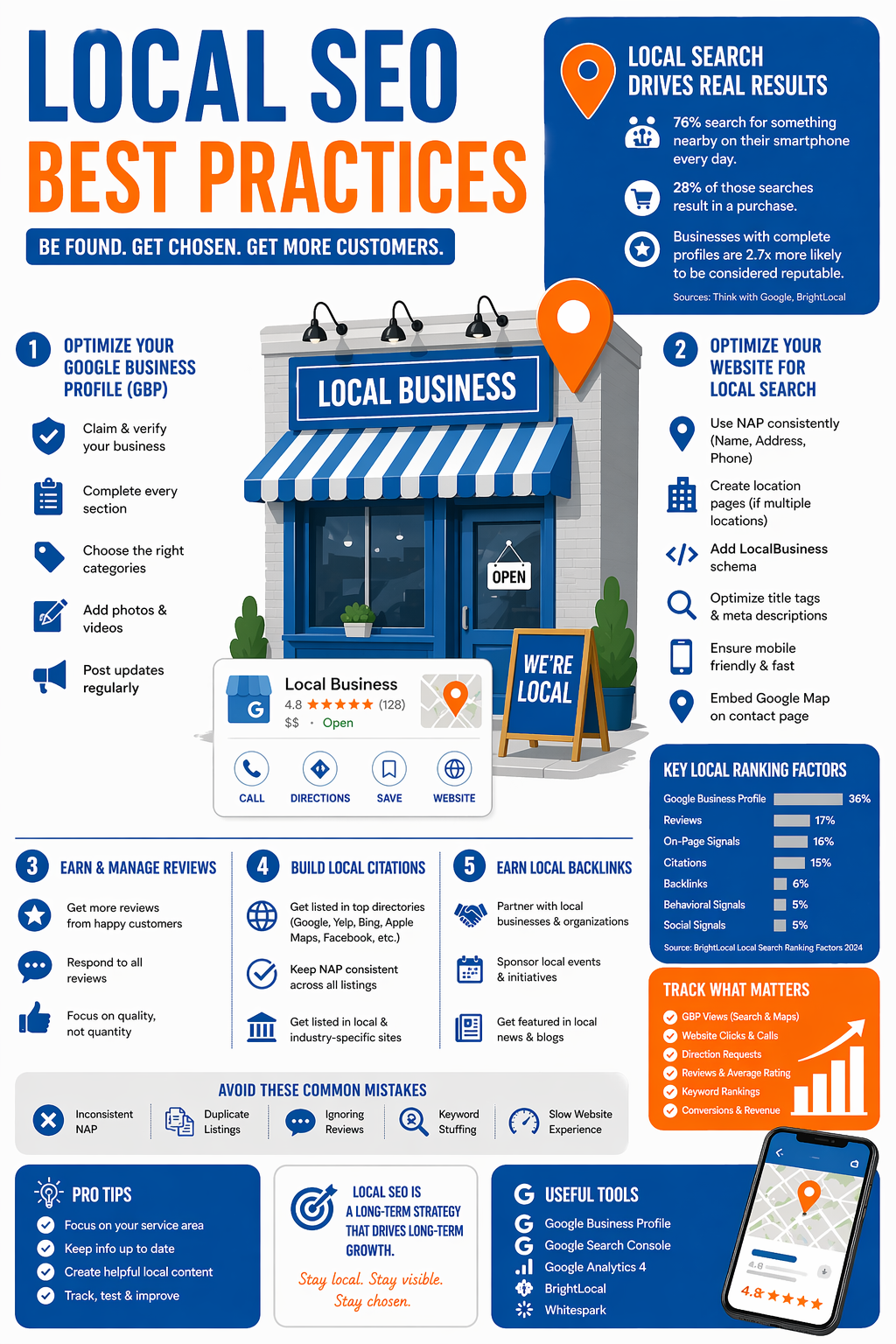
Local SEO for community association management is the single highest-ROI marketing investment most CAM companies aren’t making properly. When a board member searches “HOA management [city]” or “condo association management near me,” Google serves up a Map Pack—the three prominent listings with maps, star ratings, and phone numbers that appear before any organic results. If you’re not in that Map Pack, you’re invisible to the majority of searchers.
The Google Business Profile Is Not a Set-It-and-Forget-It Asset
Most HOA management companies created their Google Business Profile years ago and haven’t touched it since. That’s a significant problem. Google’s local ranking algorithm factors in activity, completeness, review velocity, and content freshness. A profile that’s been sitting dormant is getting outranked by competitors who are regularly posting updates, responding to reviews, adding photos from community projects, and maintaining current service descriptions.
Your Google Business Profile should include your full service list with detailed descriptions for each service category, real photos from actual communities you manage (not stock photos), your complete service area with every city and municipality you cover, regular Google Posts sharing relevant community management content, and prompt, professional responses to every single review—positive and negative alike.
Location Pages Done Right
If you serve multiple markets, you need dedicated pages for each geographic area—and those pages can’t be the same content with different city names swapped in. Google is sophisticated enough to recognize thin, templated content, and it penalizes you for it. More importantly, board members reading your Orlando page want to know that you understand Orlando HOA issues—not generic community management content with “Orlando” inserted wherever it fits.
Effective location pages for CAM companies reference state-specific HOA laws and regulations, common regional challenges (hurricane preparedness in Florida, HOA water usage regulations in Arizona, snow removal considerations in Minnesota), local contractors and vendor relationships you’ve established in that market, and specific neighborhoods, counties, or communities you have experience with. The more authentic and locally specific the content, the better it performs—in both traditional search and AI-powered search.
Keyword Strategy for CAM: Think Like a Board Member
Most CAM companies optimize for obvious terms like “HOA management” and “property management” without realizing that the highest-converting searches are far more specific. Someone searching “HOA management company with reserve study experience Tampa” is much further down the decision path than someone searching “HOA management Tampa.” The first searcher is ready to act.
Listen to the questions you get from prospects during your sales calls. The exact phrases they use, the specific problems they describe, the terminology that comes up repeatedly—those are your keyword targets. Turn those conversations into content and watch your rankings for the terms that actually convert.
Building Local Authority Through Backlinks
Google uses links from other reputable websites as a signal of your authority and trustworthiness. For local CAM companies, the most valuable links come from local business directories, Chamber of Commerce listings, CAI (Community Associations Institute) member directories, state HOA law attorney blogs that reference your content, and local news sites that cover community association issues. Creating genuinely useful content—detailed guides to state-specific HOA laws, explainers on reserve study requirements, breakdowns of management contract terms—gives people reasons to link to you organically.
Content Marketing That Actually Converts Board Members
Boards researching management companies are hungry for information. The company that educates them best almost always wins the contract.
Content marketing in the CAM space isn’t about churning out blog posts to hit a publishing quota. It’s about building a library of genuinely useful resources that demonstrates your expertise, answers the specific questions your prospects are asking, and builds the kind of trust that makes picking up the phone feel like a natural next step.
Here’s the difference between content that’s done well and content that’s just going through the motions: useful content starts from a real question a real board member would ask and answers it completely and honestly. Filler content starts from a keyword and manufactures something passable around it. Board members can tell the difference. Google increasingly can too.
Content That Performs Best for CAM Companies
The highest-performing content types for community association management companies tend to fall into a few consistent categories. Educational explainers on HOA financial topics—reserve studies, special assessments, operating budget construction, delinquency management—consistently attract board members who are early in the research process and will remember which company educated them. Comparison guides (what to look for in a management contract, full-service vs. self-management pros and cons, how to evaluate competing management proposals) attract people further along in the decision process. State-specific legal and regulatory guides attract organic links from attorneys, real estate professionals, and other authoritative sources.
Case studies and community success stories are particularly powerful because they answer the implicit question every prospect is asking: “Have you done this before, and did it work?” A detailed write-up about how you helped a 200-unit condominium association address deferred maintenance, rebuild its reserve fund, and reduce vendor costs by thirty percent over two years is concrete proof that your company delivers results. That’s the kind of content that gets saved, shared among board members, and referenced in decision conversations.
The FAQ Content Strategy
One of the most underutilized content strategies in the CAM space is building comprehensive FAQ pages around the questions prospects actually ask. Not marketing-friendly softballs, but the real questions: “What does an HOA management company actually do that a self-managed board can’t?” “How do I know if my current management company is underperforming?” “What happens to our HOA’s money during a management transition?” These questions are being typed into Google every day. The company that answers them clearly and completely wins the traffic—and often the client.
FAQ content also feeds AI search engines. When board members ask Perplexity or ChatGPT these exact questions, the platforms pull from websites that have comprehensive, well-structured answers. A thorough FAQ section built around the real questions your prospects ask gives you a meaningful advantage in AI-driven search.
Video Content: The Underutilized Differentiator
Video is still dramatically underused by HOA management companies, which makes it an opportunity. A short, well-produced video explaining what to look for when switching management companies, or walking through how your onboarding process works, does something written content alone can’t: it lets prospects see and hear you before they ever pick up the phone. In a relationship-driven business like community management, that matters more than most marketing teams acknowledge.
Reputation Management and Reviews
In community association management, your reputation isn’t just a marketing asset. It’s the whole ballgame.
Google reviews matter enormously in the CAM space, for two distinct reasons. First, they directly influence your local search rankings. The quantity, quality, and recency of your reviews are significant factors in whether you show up in the Map Pack when a board member searches for management in your market. Second, reviews are often the tipping point in the evaluation process. A board considering three management companies will frequently use reviews as the deciding factor when the other differentiators feel roughly equal.
Building a Systematic Review Acquisition Strategy
The single biggest mistake HOA management companies make with reviews is asking for them sporadically and inconsistently. A system beats random effort every single time. The system starts with identifying your highest-satisfaction moments—successful project completions, resolved conflicts, smooth budget adoption meetings, compliments from board members after particularly challenging situations. These are your windows.
Build the ask into your existing workflows. After a productive annual meeting, your follow-up email should include a review request. After you’ve resolved a significant maintenance issue, your follow-up note to the board should include the link. Train your community managers to recognize positive feedback moments in real-time and to respond with a warm, natural ask: “We’re so glad that worked out. If you ever have a few minutes, a Google review would mean a lot to our team.”
Handling Negative Reviews Like a Professional
Negative reviews are opportunities—not threats—for companies that respond to them well. A calm, professional, non-defensive response to a critical review demonstrates something powerful to every future prospect reading it: that you take concerns seriously, that you don’t dodge accountability, and that you handle conflict constructively. Those are exactly the qualities a board member wants in a management company.
The worst thing you can do is ignore a negative review or respond defensively. The second worst is to respond with a canned, obviously templated message that sounds like it was written by a PR firm at three in the morning. Respond like a human being. Acknowledge the concern, note what you’ve done or will do about it, and invite the reviewer to continue the conversation offline.
Expanding Beyond Google
Google reviews are the priority, but they’re not the only platform that matters. Your CAI member profile, Yelp presence (particularly in markets where consumers heavily use it), HOA-specific directories, and even LinkedIn recommendations from board members all contribute to the fuller picture a prospect sees when they research your company. A robust multi-platform reputation makes the decision to call you easier.
Paid Advertising for CAM Companies
Organic is the long game. Paid search is the shortcut—when it’s done right. Organic SEO and content marketing build compounding, durable value over time. But they take months to mature. If you need leads now—if you’re entering a new market, launching a new service, or have capacity to fill quickly—Google Ads can put you in front of actively searching board members immediately.
Google Ads for HOA Management Companies
The paid search landscape for community association management is genuinely competitive in most major markets, which means your campaigns need to be precise. You’re paying for every click, and not every click represents a qualified prospect. Broad match targeting on generic terms like “property management” will burn through budget on searchers looking for single-family rental management, short-term rental companies, and other services that have nothing to do with HOA management.
Intent-specific keyword targeting is everything. Focus your paid campaigns on terms with clear HOA management intent: “HOA management company [city],” “condo association management services,” “community association manager near me.” Use negative keywords aggressively to filter out irrelevant traffic. And make sure your ad landing pages are purpose-built for conversion—not your homepage, but a dedicated page that speaks directly to the prospect who clicked that specific ad.
Retargeting: Staying Top of Mind Through the Long Research Cycle
The decision cycle for switching HOA management companies is typically sixty to one hundred and twenty days. Board members don’t flip a switch; they research, discuss at meetings, compare proposals, and deliberate. Retargeting campaigns—ads that follow your website visitors around the web after they’ve visited your site—keep your company visible throughout that entire process. When the board finally votes and the president sits down to send that first outreach email, you want yours to be the name they type.
Email Marketing and Lead Nurturing for CAM Companies
Getting the inquiry is step one. Turning that inquiry into a signed contract takes a deliberate nurturing strategy. Most HOA management companies treat lead follow-up as an afterthought. Someone submits a contact form, the company sends one email, maybe makes one call, and if there’s no immediate response, that lead quietly disappears from the radar. Meanwhile, that board is still evaluating three other companies over the next sixty days.
Current Client Communication as a Retention and Referral Engine
Email marketing isn’t only for prospects. Your current clients are your most valuable marketing asset if you treat them that way. Regular, genuinely useful communication—legislative updates affecting HOAs in your state, budgeting timelines and reminders, vendor market updates, reserve study refreshers—keeps you visible as a proactive partner rather than someone who’s only heard from when there’s a problem. Clients who feel genuinely supported become your referral engine. They tell other board members about you. In a relationship-driven industry, that word-of-mouth value is irreplaceable.
Measuring What Actually Matters
You can’t improve what you don’t measure. But most CAM companies are tracking the wrong things. You can’t improve what you don’t measure. But most CAM companies are tracking the wrong things. Marketing metrics can feel overwhelming—there are more dashboards, tools, and data points available today than anyone could meaningfully absorb. The trick is knowing which numbers actually connect to business outcomes and ignoring the vanity metrics that feel meaningful but don’t.
The Metrics That Drive CAM Marketing Decisions
Organic search traffic is important, but it’s not the whole picture. What you really want to know is how many of your website visitors are in your target geography, how many of them are visiting your service pages (which indicates purchase intent), and how many of them take a conversion action (submitting a form, calling your number, clicking to email). Traffic from board members in your market who are actively researching management companies is worth infinitely more than a thousand visits from people who found a general blog post about HOA financial management and have no need for your services.
Google Business Profile insights tell you how many people saw your listing in local search, how many visited your website from the profile, how many called your phone number, and how many requested directions to your office. These are direct indicators of local search performance. Most management companies never look at this data.
Lead source tracking is absolutely essential. Every inquiry that comes in should be tagged with how that person found you. Organic search, Google Ads, referral, Google Maps, direct—understanding which channels are generating your most valuable leads (not just the most leads, but the leads that convert to signed contracts) tells you where to invest more and where to pull back.
Setting Realistic Timelines
One of the most common frustrations in CAM marketing is expectation mismatch. Companies invest in SEO for six weeks, don’t see a dramatic increase in leads, and pull back before the investment has had time to compound. Local SEO for a management company in a competitive market typically takes four to six months to show meaningful ranking improvements, and twelve months or more to reach full competitive maturity. Paid search can generate leads in days. Content marketing compounds over years. Understanding which channel operates on which timeline helps you set expectations, stay patient where patience is required, and celebrate early wins appropriately.
Frequently Asked Questions: CAM Marketing Strategy
The questions we hear most often from community association management companies working to grow their client base online.
How long does it take for CAM marketing and SEO to start generating real leads?
It depends heavily on the channel. Google Ads can generate qualified inquiries within the first week or two. Local SEO typically takes four to six months to produce noticeable ranking improvements in competitive markets, and a full twelve months to reach its potential. Content marketing compounds over time—articles and guides published today may continue generating leads three to five years from now. The key is understanding that organic channels require patience and consistency. Companies that treat SEO like a light switch—turning it on for a few months and expecting instant results—consistently underperform compared to companies that commit for the long term.
How much should a community association management company budget for digital marketing?
The right budget depends on your market size, your current digital presence, and your growth goals. As a general benchmark, CAM companies seriously investing in growth typically spend between three and eight percent of gross management revenue on marketing. In highly competitive markets (South Florida, Phoenix, Las Vegas), the effective floor is higher. A more useful frame than a fixed percentage is thinking about cost per acquired client: if your average management contract is worth $24,000 to $36,000 in annual revenue, spending $2,000 to $3,000 in marketing costs to acquire one new contract represents an excellent return on investment.
Is it worth doing paid advertising if my organic SEO is already strong?
Yes, for several reasons. First, paid search and organic search capture different users. Someone in a hurry may click the first result regardless of whether it’s paid or organic. Second, paid campaigns give you precise control over targeting and messaging that organic results don’t. Third, Local Services Ads appear above both organic results and traditional paid ads, so they can be additive even if your organic rankings are strong. And fourth, paid search generates real-time data about which keywords, messages, and offers convert that can be used to inform and improve your organic and content strategy.
How do I compete with the large national HOA management companies that dominate Google in my market?
Local specificity is your competitive advantage. National management companies have brand recognition and marketing budgets, but they can’t out-local you. They can’t reference the specific neighborhoods you manage in your city by name. They can’t write credibly about your state’s unique HOA regulatory environment. They can’t generate dozens of reviews from local board members in your market. Your local SEO strategy, location-specific content, and authentic community presence are the tools that consistently outperform national competitors in localized search results.
What’s the most common mistake HOA management companies make in their marketing?
Talking about themselves instead of their prospects. The vast majority of CAM company websites, social profiles, and marketing materials are organized around the company’s features, history, and credentials. The problem is that board members showing up on your website aren’t there to learn about your founding story—they’re there because something in their community is broken and they need to know if you can fix it. Companies that lead with the prospect’s pain, speak directly to the specific problems that drive management searches, and provide genuine evidence of their ability to solve those problems dramatically outperform companies whose marketing is self-focused.
Do I need to be active on social media to market my HOA management company effectively?
Social media for B2B service companies like HOA management is not a primary lead generation channel in most cases. Board members don’t typically scroll Instagram looking for a new community manager. Where social media earns its keep for CAM companies is in the supporting role: building credibility, demonstrating expertise, and providing an additional touchpoint for prospects who look you up after finding you through search. LinkedIn is the most relevant platform for reaching board members and HOA professionals. A consistent, professional LinkedIn presence builds trust and occasionally generates direct outreach from communities in your market. It’s worth maintaining, but it shouldn’t come at the expense of your SEO and website investment.
How do I market my CAM company to developers and newly formed HOAs?
Newly formed associations and developer-phase communities represent a different marketing challenge because the search behavior is different. Developers typically research management companies during the planning phase—before the HOA is formally activated—and they prioritize experience with the transition from developer to homeowner control, familiarity with state requirements for HOA formation documents, and the ability to handle the often-complex early operational period. Marketing to developers means building content and relationships targeted specifically at that transition phase, attending developer industry events, building relationships with HOA attorneys and developers directly, and having case studies that specifically address developer-phase community management.
What’s more valuable for CAM lead generation—quantity or quality of Google reviews?
Both matter, but quality compounds over time while quantity creates the floor. Google’s algorithm considers the number, recency, and rating of reviews in local search rankings, which means you need a consistent volume of fresh reviews to maintain and improve your Map Pack position. But the content of reviews—the specificity, the detail, the specific problems mentioned and resolved—is what actually converts prospects who are reading them. A hundred five-star reviews that all say “great company!” are less persuasive than forty detailed reviews that describe specific situations, name specific team members, and explain what specifically improved after switching to your management company.
Should I have separate websites for different geographic markets, or one central site?
One central, well-structured website with dedicated location pages for each market is the correct architecture for most CAM companies. Separate domain names for each market create SEO fragmentation—you’re splitting your domain authority across multiple sites instead of concentrating it. The exception might be a holding company structure with genuinely distinct brands operating in different markets under different names. Otherwise, build deep, location-specific content within a single strong domain. That’s the structure that builds cumulative authority fastest.
How do I know if my current marketing agency is actually delivering results for my CAM business?
Ask for a report that connects marketing activity to business outcomes—specifically, how many qualified leads were generated in the period, what was the source of those leads, what did they cost per lead, and how many converted to management contracts. Any agency that can’t (or won’t) connect their work to actual business outcomes is not delivering a service worth paying for. Vanity metrics—impressions, follower counts, “reaches”—are not indicators of marketing ROI. Leads, calls, form submissions, proposals, and signed contracts are. If your current agency’s reporting stops short of those outcomes, that’s a serious problem.
Conclusion: Building a CAM Marketing System That Compounds
Every well-managed community in your market is a potential client. The question is whether they’ll find you when they’re ready to make a change.
The CAM companies that consistently win new contracts in their markets share a few defining characteristics. They have a clear, compelling web presence that speaks directly to the problems board members are dealing with. They dominate their local search results through a combination of strong Google Business Profiles, location-specific content, and a steady stream of genuine client reviews. They’ve built a library of educational content that positions them as the most knowledgeable resource in their market. And they follow up with prospects through a deliberate, organized process that keeps them present through the full decision cycle.
None of this happens overnight. But the compounding nature of a well-built digital presence means that the investments you make today pay dividends for years. An article published this month might generate its hundredth qualified lead three years from now. The review you collect from a satisfied board president today influences the next ten communities who read your profile. The local SEO work done this quarter becomes the foundation your paid campaigns amplify next year.
The market isn’t waiting. There are board members in your city searching for a new management company right now. The only question is whether they’ll find you.
Ready to build a CAM marketing strategy that actually delivers results?
Big Rock Marketing specializes exclusively in marketing and SEO for community association management companies. We know the industry, we know the search landscape, and we know what it actually takes to fill your pipeline with qualified communities in your market.
Visit bigrockonline.com to see our full suite of CAM marketing services, read more expert guides, or request a free competitive analysis of your market.